Disclosure: This post contains affiliate links. If you click through and make a purchase, we may earn a small commission at no extra cost to you. Thank you for supporting this site!
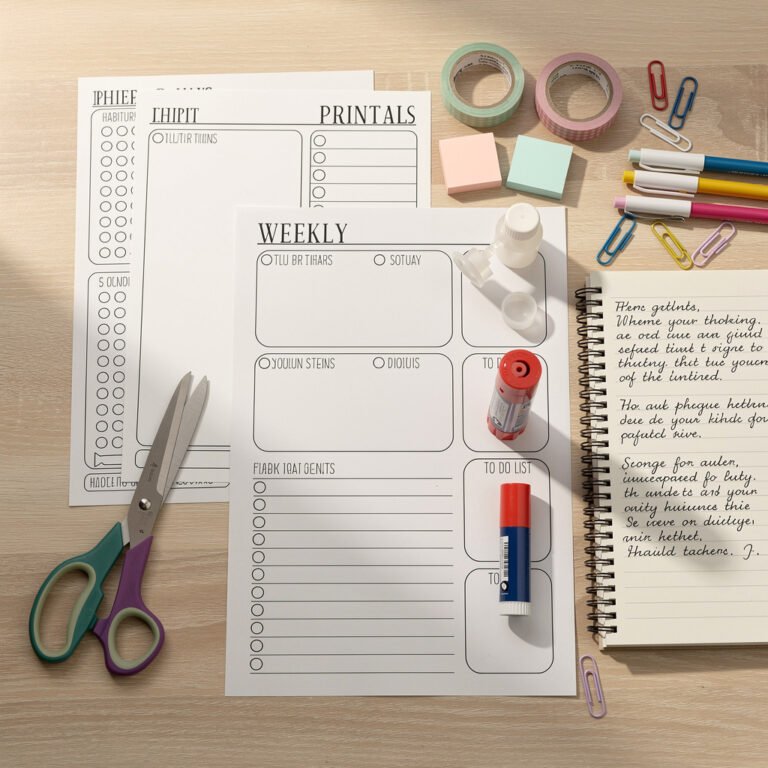
50 Bullet Journal Templates Pack
Ready-to-print spreads for habit tracking, weekly planning, mood logs, and creative layouts.
If you have ADHD, you’ve probably tried every planner system on the market—only to abandon each one within weeks. Traditional planners expect linear thinking, rigid schedules, and consistent follow-through, all of which can feel nearly impossible for a neurodivergent brain. The bullet journal offers a different path. It’s not a pre-printed calendar you have to fit into; it’s a flexible, customizable system that bends to the way your brain actually works. With the right layouts, you can capture racing thoughts, visualize time in a way that makes sense, and track habits without triggering shame. This article walks you through ADHD-friendly bullet journal spreads designed to reduce overwhelm, build momentum, and help you focus—without demanding perfection. Whether you’re new to bullet journaling or returning after a few abandoned attempts, these layouts meet you where you are.
Why Traditional Planners Fall Short for the ADHD Brain
Standard planners are built on an assumption of neurotypical executive function. They expect you to estimate time accurately, remember appointments days in advance, and maintain a consistent routine without external reinforcement. For many people with ADHD, these are exactly the skills that need support, not assumptions. A traditional daily planner with hour-by-hour slots can feel like a trap—one missed block throws off the entire day, and the resulting shame often derails any remaining motivation. Research from the ADHD brain’s relationship with time perception shows that “time blindness” makes rigid scheduling almost counterproductive.
Instead of forcing conformity, bullet journaling lets you design layouts that accommodate variable focus and energy levels. You can build in “overflow” space for tasks you didn’t finish, add a brain dump section to clear mental clutter, and use collections that evolve as your priorities shift. The key is that your journal works for you, not the other way around. By damping down the shame of unfinished pages and embracing modular, forgiving spreads, you create a planning system that actually supports neurodivergent rhythms. The bullet journal’s core philosophy—rapid logging, migration, and collections—already aligns with how ADHD brains naturally process information, making it a uniquely effective tool for focus and follow-through.
- Rigid hourly schedules increase anxiety and shame when missed.
- Linear layouts fail to capture nonlinear, scattered thinking.
- Pre-printed pages offer no room for customization or mid-week pivots.
- ADHD brains thrive on visual, flexible, and forgiving systems.
The Brain Dump Spread — Clear the Mental Clutter
A brain dump spread is one of the most effective ADHD bullet journal layouts because it externalizes the constant stream of thoughts, worries, and ideas that can make focus feel impossible. Instead of trying to hold everything in your head—and inevitably dropping half of it—you dedicate one or two pages to capturing anything that comes up. This isn’t a to-do list; it’s a judgment-free zone where you write down whatever surfaces: a grocery item, a work deadline, a random memory, a creative spark. The simple act of getting it onto paper can reduce cognitive load and free up mental bandwidth for the task at hand.
To make this spread work for you, choose a format that feels low-pressure. Some people prefer a simple list on a fresh page, while others use a “mind map” style with bubbles and lines connecting related ideas. You can also try a “traffic light” system with three columns: urgent, soon, and someday. The goal is not organization but release. Once the dump is complete, you can scan for any immediately actionable items and migrate them to a daily or weekly log. The rest stays on the page as a reference you can revisit later—no guilt, no pressure to do it all right now. Over time, the brain dump becomes a trusted tool for quieting mental noise and creating space for intentional focus.
- Open to a fresh two-page spread and set a timer for 5 minutes.
- Write down everything in your head—work tasks, worries, ideas, reminders.
- Use symbols or colors only if they help; otherwise, keep it simple.
- After the timer, scan for 1-3 items to act on today. Leave the rest.
- Revisit the page weekly to close out or migrate lingering items.
Time Blocking That Flexes with Your Focus
Traditional time blocking often fails for ADHD because it assumes you can predict how long a task will take and maintain focus for extended periods. Instead of rigid hour-by-hour blocks, try a “flexible time blocking” layout that builds in buffers, transition time, and room for hyperfocus. Draw a simple vertical timeline with 2-3 hour chunks rather than 15-minute increments. Label each chunk with a broad intention—like “morning anchor task,” “afternoon catch-up,” or “creative flow”—rather than specific task assignments. This reduces the cognitive load of scheduling while still providing structure.
Color-code each block by energy demand, not by task category. For example, use orange for high-focus work, blue for low-focus or administrative tasks, and green for rest or transition. This visual system helps you match tasks to your current energy level without overthinking. If you’re in a low-energy moment, you can glance at your timeline and pick a blue-block task without guilt. Data from ADHD productivity research suggests that external visual cues reduce decision fatigue and improve task initiation. Pair this layout with a simple “done list” at the end of the day, where you record what you actually accomplished—not what you planned—to reinforce a sense of progress rather than failure.
Low-Effort Daily Logs — Start Small, Build Momentum
One of the biggest barriers to sticking with a bullet journal is the pressure to create elaborate, artistic daily spreads. For the ADHD brain, the setup time alone can be enough to derail the habit. Instead, adopt a minimalist daily log that takes less than 60 seconds to create. Use a simple rapid-logging format: date, a short bulleted list of tasks and events, and a small notes section for random thoughts. Use dots for tasks, circles for events, and dashes for notes—just as Ryder Carroll originally designed. No washi tape, no banners, no calligraphy required.
The real power of the low-effort log is that it lowers the barrier to entry. You’re far more likely to show up consistently when the cost of creating a page is near zero. If you miss a day—or a week—just start again on the next blank page. No gap-filling, no guilt. Research on habit formation shows that the key to consistency is reducing friction, and a simple daily log does exactly that. To add a touch of support, include a small “focus anchor” at the top of each day: one word or phrase that represents your primary intention (e.g., “breathe,” “finish report,” “rest”). This anchors your day without adding complexity.
Habit Tracking Without the Shame Spiral
Habit trackers are a staple of the bullet journal world, but they can easily become a source of shame for ADHD brains when streaks are broken. Instead of
Related from our network
- AI Productivity Apps Reviewed: What Saves Time vs What's Just Hype (aidiscoverydigest)
- AI Productivity Stack: Tools to Work Smarter, Not Harder (wealthfromai)
- 50 AI Prompts That Boost Productivity and Creativity (wealthfromai)