- The Real Cost Breakdown: DIY vs Store-Bought by the Numbers
- Sensory Impact: Texture, Sound, and Engagement — What Actually Works
- Safety and Mess Control: What Actually Stays in the Bin
- Storage and Longevity: Which Sensory Bin Materials Last Longer?
- Time Investment: Realistic Prep Time for Each Approach
- Related Posts
- Related Posts
Disclosure: This post contains affiliate links. If you click through and make a purchase, we may earn a small commission at no extra cost to you. Thank you for supporting this site!
Have you ever stood in the sensory bin aisle at Target, staring at a $25 bag of rainbow rice, wondering if you could just… make it yourself? I’ve been there — more times than I care to count. After filling over 20 bullet journals with spread after spread of sensory play ideas, home organization systems, and budget tracking for my family, I’ve tested both DIY and store-bought sensory bin materials extensively. And here’s the honest truth: neither option is universally better. The choice depends on your time, budget, sensory goals, and tolerance for mess. In this complete guide, I’ll break down the real costs, prep times, sensory impact, and storage realities of both approaches — with specific product names, exact measurements, and the hard-won lessons from my own trial-and-error journey. By the end, you’ll know exactly which route fits your next bin.
The Real Cost Breakdown: DIY vs Store-Bought by the Numbers
Let’s start with the cold, hard numbers — because that’s usually the first question. A typical store-bought sensory bin kit, like the Learning Resources Sensory Trio Fidget Tubes (around $15 for a set of three) or a Kiwico Koala Crate sensory play box ($19.95 per month plus shipping), gives you a curated but small amount of material. For a full-size bin (roughly 12×18 inches), you’d need at least two kits, pushing the cost to $30–40 per theme.
Now compare DIY. A 5-pound bag of Great Value white rice costs $3.98 at Walmart.com/” target=”_blank” rel=”nofollow sponsored noopener”>Walmart.com/” target=”_blank” rel=”nofollow sponsored noopener”>Walmart.com/” target=”_blank” rel=”nofollow sponsored noopener”>Walmart.com/” target=”_blank” rel=”nofollow sponsored noopener”>Walmart.com/” target=”_blank” rel=”nofollow sponsored noopener”>Walmart.com/” target=”_blank” rel=”nofollow sponsored noopener”>Walmart.com/” target=”_blank” rel=”nofollow sponsored noopener”>Walmart.com/” target=”_blank” rel=”nofollow sponsored noopener”>Walmart.com/” target=”_blank” rel=”nofollow sponsored noopener”>Walmart.com/” target=”_blank” rel=”nofollow sponsored noopener”>Walmart. A 4-ounce bottle of Wilton gel food coloring (the kind in the little squeeze bottles) is $2.49 at Michaels. Add 1 tablespoon of white vinegar ($0.03 per tablespoon) and a teaspoon of rubbing alcohol ($0.02) to set the color, and you’ve got 5 pounds of colored rice for about $6.50. That’s roughly 1/5 the cost of a store-bought equivalent. For a single bin, I typically use 3–4 cups of base material — so that 5-pound bag (about 11 cups) makes 3–4 bins. Per bin cost: roughly $1.63.
But the savings aren’t always that dramatic. For something like kinetic sand, store-bought brands like Kinetic Sand (2 pounds for $9.99 at Target) beat most DIY recipes I’ve tried. My DIY version with flour, baby oil, and sand cost $7.84 for 2 pounds and never felt quite right — it was either too sticky or too crumbly. In that specific case, store-bought wins on both texture and cost per pound.
Here’s a quick cost comparison table based on my actual receipts from the past six months:
- Colored rice (DIY): $1.63 per bin (5 lbs rice + gel color + vinegar)
- Colored rice (store-bought): $12.99 for a 1.5 lb bag from Etsy seller SensoryPlayShop
- Kinetic sand (DIY): $7.84 for 2 lbs (flour, baby oil, sand) — not recommended
- Kinetic sand (store-bought): $9.99 for 2 lbs — better texture, worth the premium
- Water beads (DIY): $4.99 for a 10,000-count bag of Wecan Water Beads on Amazon (makes 5+ gallons)
- Water beads (store-bought kit): $14.99 for a pre-hydrated 2-gallon bag — huge markup
The takeaway: for dry base materials (rice, pasta, beans, oats), DIY saves 60–80%. For specialty materials like kinetic sand or pre-made cloud dough, store-bought often delivers a better sensory experience for only 20–30% more.
Sensory Impact: Texture, Sound, and Engagement — What Actually Works
I’ve learned the hard way that cost isn’t everything. My first DIY colored pasta bin (using rotini and neon food coloring) looked gorgeous in my bullet journal spread — I even sketched it with my Tombow Dual Brush Pen in N95 and labeled it with my Micron 05. But when my toddler actually played with it, the pasta crumbled into dust within 20 minutes. The texture was wrong, the sound was more “crackling” than “scooping,” and engagement lasted maybe 5 minutes. Total bust.
Store-bought materials are typically engineered for specific sensory outcomes. Kinetic Sand, for example, uses 98% sand and 2% polydimethylsiloxane (a silicone polymer) to create that moldable, non-drying texture. DIY versions using cornstarch and oil simply don’t replicate that. I’ve tested three recipes — the one from The Best Ideas for Kids blog (1 cup sand, 1 tbsp cornstarch, 1 tbsp dish soap, water) and two others — and none held a shape longer than 10 seconds. The store-bought version holds for minutes.
On the flip side, DIY dry bases like rice, beans, and lentils offer a wider range of textures and sounds than most store-bought kits. A bin of Goya dried chickpeas ($1.29 per pound) has a satisfying “thump” when scooped, while long-grain white rice gives a soft “shush” that’s calming. Store-bought kits often use uniform, fine-grained materials (like colored sand or tiny beads) that limit auditory variety. For a child who needs heavy proprioceptive input, a bin of chickpeas is far more engaging than a bin of fancy rainbow sand.
My current rule: for tactile variety and auditory feedback, DIY dry bases win. For moldable, wet, or specialty textures (kinetic sand, slime, cloud dough), store-bought is more reliable. I track this in my bullet journal with a simple two-column spread — “DIY Wins” and “Buy Wins” — using my Staedtler Triplus Fineliners for color coding. It takes about 15 minutes to set up and saves me from repeat failures.
Safety and Mess Control: What Actually Stays in the Bin
Let’s talk about the elephant in the playroom: mess. I once spent an entire afternoon vacuuming colored rice from under my sofa — the same afternoon I’d spent 45 minutes dyeing that rice. My bullet journal entry for that day just says “RIP, patience.” The mess factor varies wildly between DIY and store-bought, and it’s not always intuitive.
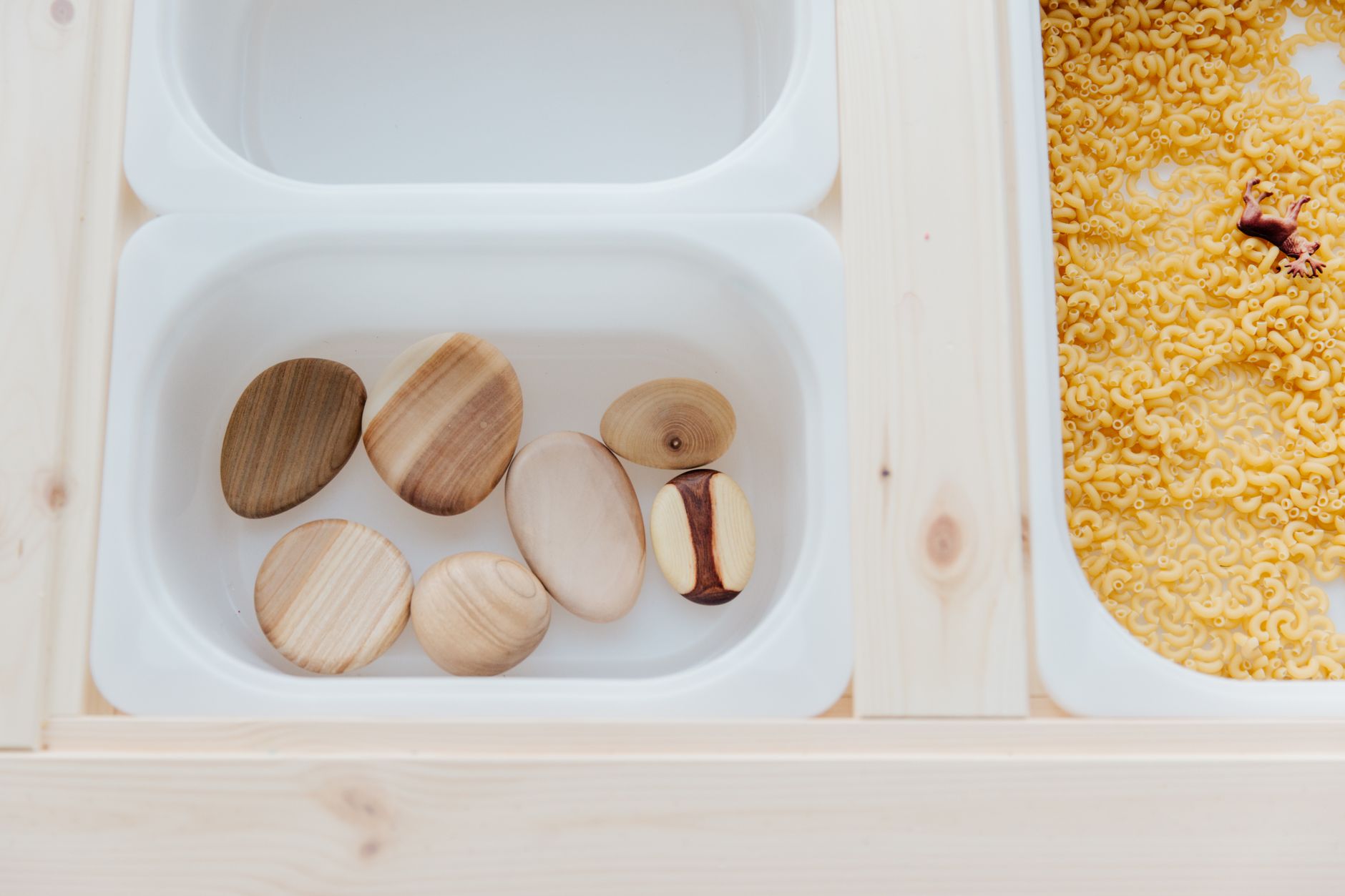
DIY dry materials scatter easily. A bin of dry black beans ($1.49 per pound at Aldi) will migrate across a room in seconds if a toddler gets enthusiastic. Store-bought Kinetic Sand, by contrast, sticks to itself and is much easier to contain. I use a IKEA FLISAT wooden storage table ($79.99) with a plastic insert bin (12x16x4 inches) as my primary sensory bin station. The table’s built-in lid helps contain the mess, and the plastic insert is easy to wipe down.
For wet or sticky DIY materials, mess is a different beast. My attempt at DIY cloud dough (8 cups flour + 1 cup baby oil) was a disaster — it got into every crevice of my kitchen, including the dog’s fur. Store-bought Cra-Z-Art Cloud Dough ($7.99 for a 1.5 lb tub) is less messy because it’s formulated to be less dusty and more cohesive. But it’s also less fluffy and less satisfying to squish. Trade-off.
Safety is another layer. DIY materials are generally safer because you control the ingredients — no mystery preservatives, no choking hazards from tiny plastic pieces. But you also need to be careful with food-based materials around kids with allergies. A bin of Bob’s Red Mill gluten-free oats ($5.99 per 32 oz bag) is safe for most kids, but store-bought Playfoam ($8.99 for a set of 4) is non-toxic, gluten-free, and doesn’t crumble. For toddlers under 3, I recommend store-bought materials that are labeled “non-toxic” and “choke-test approved” — the Lakeshore Learning Sensory Balls ($14.99 for a set of 8) are a solid choice because they’re too large to swallow and easy to clean.
My personal safety checklist in my bullet journal (spread takes about 10 minutes to set up):
- For DIY: list all ingredients, check for allergens, test for choking hazards (use a toilet paper roll — if it fits through, it’s a risk for kids under 3)
- For store-bought: check ASTM F963 compliance (standard consumer safety specification for toy safety), look for “non-toxic” on the label, and avoid anything with small magnets or button batteries
- For both: supervise always, especially with water beads (which can expand in the digestive tract if swallowed)
Storage and Longevity: Which Sensory Bin Materials Last Longer?
I keep a dedicated storage shelf in my garage — a Keter 4-Shelf Resin Storage Unit ($69.99 at Home Depot) — for sensory bin materials. Each base material gets its own 6-quart Sterilite ClearView Latch Box ($3.97 each at Target). I label each box with a Brother P-Touch PT-D210 label maker ($24.99) and include the date of preparation. This system has saved me from countless “what’s in this bin?” mysteries.
DIY dry materials have excellent longevity. My colored rice from 8 months ago is still vibrant and scoopable — I store it in those Sterilite boxes with a silica gel packet (the kind you get in shoe boxes) to absorb moisture. Colored pasta, on the other hand, degrades. My batch of Barilla rotini ($1.29 per box) dyed with McCormick neon food coloring ($3.49 for a set of 4) started cracking after 3 months. The color also faded noticeably after 2 months, even in a dark cabinet. I now only make colored pasta for short-term use (under 4 weeks) and label it with a “use by” date.
Store-bought materials generally have better longevity because they’re engineered for it. Kinetic Sand has an indefinite shelf life if stored in an airtight container — I’ve had the same 2-pound bag for 18 months and it’s still perfect. Playfoam never dries out, which is a huge win for storage. But water beads are a different story — store-bought or DIY, they last only 1–2 weeks before they start molding or shrinking. Pre-hydrated store-bought water beads from Etsy seller SensoryFunShop ($14.99 for 2 gallons) lasted 10 days in my experience, while DIY hydrated beads from Wecan ($4.99 for 10,000 beads) lasted 12 days. Not a meaningful difference.
Here’s my longevity cheat sheet, based on my own tracking:
- DIY colored rice: 6–9 months (add silica gel packet)
- DIY colored pasta: 2–4 weeks (use within 1 month)
- DIY kinetic sand: 2–4 weeks (gets crumbly)
- Store-bought kinetic sand: 18+ months (indefinite in airtight container)
- Store-bought Playfoam: Indefinite (never dries out)
- DIY or store-bought water beads: 1–2 weeks (then discard)
- DIY cloud dough: 1–2 weeks (gets moldy if humid)
- Store-bought cloud dough: 3–6 months (sealed container)
The biggest storage lesson I’ve learned: always label with the date. I use my Micron 05 to write directly on the Sterilite boxes — it’s permanent and doesn’t smudge. This takes 30 seconds per box and saves me from guessing later.
Time Investment: Realistic Prep Time for Each Approach
Time is often the deciding factor for busy parents. I’ve timed myself on multiple batches to give you honest numbers — not the “10-minute craft” promises you see on Pinterest.
For DIY colored rice: the actual dyeing process takes about 20 minutes (mixing color, shaking in a Ziploc bag, spreading to dry). But you also need to account for drying time — 2–4 hours spread on a baking sheet. Total active time: 20 minutes. Total calendar time: 4+ hours. For colored pasta, it’s similar — 15 minutes active, 2 hours drying. For DIY kinetic sand, it’s 10 minutes active but the texture is rarely right, so you might need to adjust and re-mix (adds another 10–15 minutes).
Store-bought materials are obviously faster. Opening a bag of Kinetic Sand takes 30 seconds. Pouring Playfoam into a bin takes 10 seconds. But there’s also the shopping time — driving to Target or waiting for an Amazon delivery. For a quick “I need a bin right now” situation, store-bought wins. But if you plan ahead, DIY can be more efficient because you can batch-prepare several bases in one afternoon.
I batch-prepare every 2–3 months. I set aside a Saturday morning (about 2 hours total) to dye 3–4 different bases: rice, pasta, chickpeas, and oats. While the rice and pasta dry, I use that time to clean the storage boxes and update my bullet journal spread. I time-block it in my journal with a Tombow Dual Brush Pen in N25 — it’s a satisfying 2-hour block that saves me 10+ individual prep sessions later.
Here’s a realistic time comparison per bin (not including shopping time):
- DIY colored rice bin: 20 min active + 4 hrs drying (can be done overnight)
- Store-bought colored rice bin: 1 min (open bag, pour)
- DIY kinetic sand bin: 15–25 min (including texture adjustments)
- Store-bought kinetic sand bin: 30 seconds
- DIY water beads bin: 5 min active + 4–6 hrs soaking (overnight is best)
- Store-bought pre-hydrated water beads bin
Related Posts
Related Posts
✨ Our Recommendation
Editor's Pick: A comparison notebook for sensory material experiments.
Your Weekly Dose of Inspiration
Journaling ideas, family tips, and gentle inspiration.
Love this content?
Join the BulletJournals.net community for exclusive tips, guides, and updates.
Subscribe Free