Unlock Your Creativity: Mastering Bullet Journaling
A bullet journal can be a planner, sketchbook, project notebook, memory keeper, and idea laboratory without becoming cluttered with unnecessary systems. At its best, it helps you capture tasks quickly, notice how your time is actually spent, and make room for the creative work that easily disappears beneath daily obligations. By learning the core structure and adapting it to your routines, you will be able to organize responsibilities, develop ideas, track meaningful progress, and design a notebook that supports your life rather than dictating it.
The method does not require expensive stationery, artistic talent, or hours of decoration. It requires a notebook, a reliable pen, a few intentional symbols, and a repeatable review rhythm. The creative possibilities emerge once that simple foundation is in place. A blank page becomes a weekly plan, a character becomes the first line of a story, a rough timetable becomes a finished painting session, and scattered ambitions become projects with visible next steps.
Understand the Method Before Decorating the Pages
Bullet journaling is an analog system for recording the past, organizing the present, and planning the future. Its strength comes from rapid logging: writing information in short, meaningful entries instead of composing polished diary passages. A task might appear as “Cut fabric samples,” an event as “Portfolio review, 3 p.m.,” and a note as “Try ultramarine with raw umber.” Each entry is brief enough to capture in the moment but specific enough to guide later action.
Tasks, events, and notes can be assigned simple symbols. An open square can mark a task, a filled square can show that it is complete, and a right-facing arrow can indicate migration to another date. A circle can represent an event, while a dash can identify a note. These marks are tools, not rules. If stars help you recognize high-priority work or exclamation points reveal urgent ideas, add those symbols to your key and use them consistently.
Migration is the habit that turns the notebook into an active decision-making tool. During a daily or monthly review, unfinished tasks are not copied automatically. Each one is considered: complete it, reschedule it, turn it into a project, delegate it, or discard it. Moving “Practice lettering” from Tuesday to Thursday is useful; repeatedly carrying it forward for six weeks without asking why may reveal an unrealistic goal, an unclear next action, or a commitment that no longer matters. Migration creates friction in the right place, forcing you to choose what deserves your attention.
The system also separates planning from performance. A beautiful page does not make a project successful, and an imperfect page does not make the method a failure. The notebook records decisions, evidence, and intentions. Its value is measured by whether you can find what matters, understand your patterns, and return to unfinished work with less mental effort. Decoration can make the practice enjoyable, but clarity should always come first.
Choose a Practical Toolkit and Set Up the Notebook
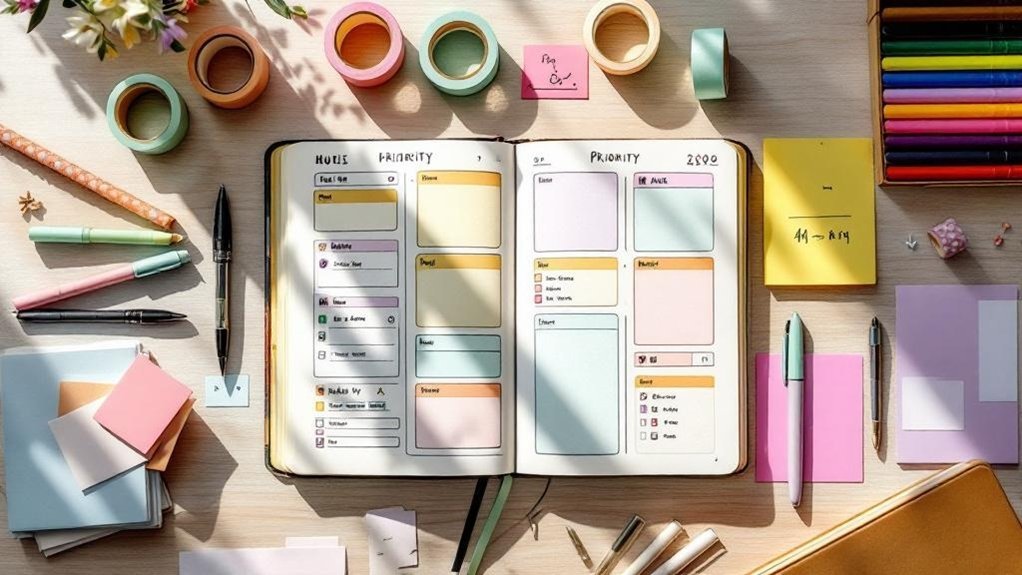
A standard A5 dotted notebook is a useful starting point because it is portable while still offering enough writing space. A 160- to 240-page notebook usually lasts three to six months, depending on how densely it is used. Prices commonly range from $12 for a basic brand to $25 or more for thicker, lay-flat paper. Look for paper around 100 gsm if you use fountain pens or light markers; ordinary gel pens and ballpoints perform well on lighter paper. A black pen costing $2 to $5 is enough for most pages. Add a $1 ruler, a $3 pack of page tabs, and perhaps a $4 roll of washi tape, but treat those extras as optional.
Before creating the first monthly spread, reserve approximately 40 to 60 pages at the front for a future log. In a 192-page notebook, pages 1 through 48 can hold 12 future months at four pages each. Write the month name at the top of each pair of pages and use the space for events, deadlines, birthdays, travel dates, and long-term projects. This prevents important commitments from being stranded on loose paper while leaving the rest of the notebook flexible.
Reserve the next eight to twelve pages for an index. Number every printed page if the notebook is not already numbered. Each time you begin a meaningful spread, record its title and page range in the index. For example, “March Monthly Log — 51–58,” “Book Ideas — 73–76,” and “Studio Budget — 102” can be entered in under a minute. A two-column index is easier to scan than a single narrow column, and pencil page numbers are useful when you expect to rearrange or remove pages.
Create a one-page key near the front of the notebook. Include only the symbols you expect to use every week: task, completed task, migrated task, cancelled task, event, note, priority, and idea. Leave a small blank area for additions. Then establish a short setup ritual. Spend 15 minutes placing the future log and index, five minutes writing the key, and another 10 minutes numbering the first monthly section. This initial investment is enough to begin; there is no need to design every page before using the first one.
Build the Core Pages That Keep Ideas Moving
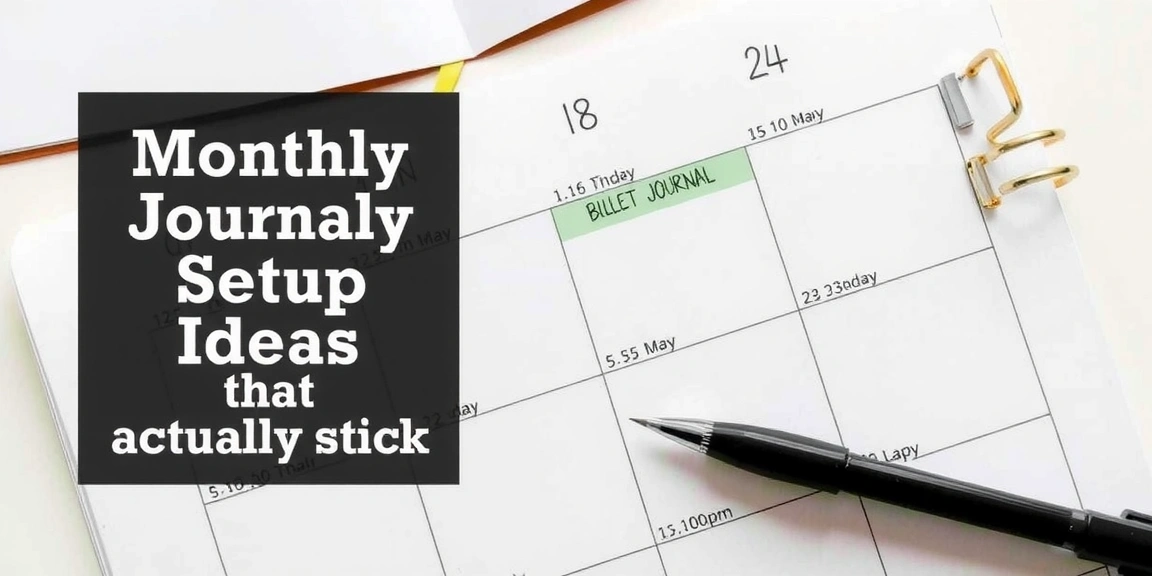
The monthly log is the bridge between long-term commitments and immediate action. Use one or two pages for a calendar view, writing fixed events and deadlines on their dates. On the following page or two, create a task list for everything that should be addressed during the month. Keep entries short but concrete: “Submit grant application,” “Buy gesso,” “Draft opening scene,” and “Schedule dentist” are more actionable than vague labels such as “art,” “writing,” or “errands.” If a task requires more than one action, give it a project collection rather than forcing a complex process into one bullet.
A daily log can be as minimal as the date and a stream of entries. Begin with three to five tasks selected from the monthly list, then add events and notes as the day unfolds. Include time-sensitive items first, followed by creative priorities. “10:00 Team meeting,” “Submit invoice,” “Sketch three cover concepts,” and “Call printer about paper weight” can coexist without elaborate boxes or color coding. At the end of the day, mark completed work, migrate what remains, and cancel anything that is no longer relevant.
Weekly spreads provide a useful middle view for people who find daily pages too narrow and monthly pages too distant. A simple two-page layout can divide the left page into seven daily columns and leave the right page for appointments, priorities, meals, or project steps. Write one primary outcome for each day rather than filling every hour. A column might contain “Finish chorus demo” on Monday, “Record vocals” on Wednesday, and “Export two mixes” on Friday. The sequence makes progress visible and helps prevent unrelated tasks from consuming the entire week.
Project pages turn an ambition into a series of manageable actions. Start with a clear desired result, such as “Produce a 24-page zine by June 15.” Below it, list the major stages: concept, writing, layout, printing, assembly, and distribution. Assign a next action to each stage and place deadlines beside the relevant items. A useful project page might specify “Choose 18 photos by April 4,” “Write 300-word introduction by April 11,” and “Request three print quotes by April 18.” Add a budget section with quantities and estimates, such as 100 copies at $3.25 each, $18 for shipping, and a $25 contingency. The page then functions as both a creative map and a financial guardrail.
Create a Review Rhythm That Fits Real Life
A five-minute morning review is enough to make the notebook useful before the day becomes busy. Open to the daily page, glance at the calendar, and select the tasks that genuinely need attention. Choose one creative priority, one administrative task, and one small action that can be completed during an unexpected gap. This prevents the page from becoming a wish list of 20 equally weighted items. If only three tasks are scheduled, finishing them creates momentum; if 15 are scheduled, the plan is probably hiding the difference between urgent and merely interesting.
Use an end-of-day review lasting five to ten minutes. Check off completed tasks, draw migration arrows beside work that will continue, and cross out items that no longer serve a purpose. Capture loose notes before they disappear: a supplier’s phone number, a line of dialogue, a color combination, or a question to research tomorrow. Do not spend this time redesigning pages or rewriting entries neatly. The goal is to leave the notebook ready for the next decision, not to produce a perfect historical record.
A weekly review of 20 to 30 minutes gives the system its broader shape. Look back at unfinished tasks and forward to the next seven days. Confirm appointments, estimate how much focused time each project needs, and schedule that time on specific dates. Review collections that may have become stale. A list of 40 story prompts is valuable only if you select one and act on it; a reading list can be reduced to the next three books. This is also a good moment to notice patterns. If creative work repeatedly migrates to Friday and is then cancelled, the issue may be exhaustion rather than poor discipline, and Saturday morning may be a more realistic slot.
Set aside 30 to 45 minutes for a monthly review. Compare planned tasks with completed work, identify the projects that advanced, and record one or two lessons without turning the page into a self-criticism exercise. Ask what consumed time unexpectedly, which commitments should be declined, and what would make next month easier. Then create the next monthly log, migrate only selected tasks, and update the index. A monthly reset can also include a 10-minute supply check: confirm that two pens are working, note when the notebook will run out, and scan important pages into a backup folder.
Keep the review rhythm adaptable during unusually busy periods. On a hectic travel week, a single line per day may be enough: one task, one event, and one note. During a creative retreat, several pages may be devoted to experiments, materials, and observations. The method remains effective because its structure responds to the volume of information rather than requiring a fixed amount of writing every day.
Use Collections and Trackers to Deepen Creative Practice
Collections are themed pages that gather related information outside the normal calendar flow. A writer might reserve four pages for character questions, six for research sources, and two for submission deadlines. A painter could create pages for pigment tests, gallery requirements, framing measurements, and ideas for a solo exhibition. Give each collection a title, page number, and purpose. A page called “Potential Essay Topics” becomes more useful when it also includes a short note about audience, estimated length, and the next research step.
Idea collections benefit from a simple selection rule. Instead of preserving every passing thought indefinitely, mark promising ideas with a star and review them weekly. Choose one idea to explore for 20 minutes, then record the result. A 20-minute sketch may reveal that a poster concept needs a stronger focal point; a short voice memo may expose a weak transition in a song. The bullet journal does not have to contain the entire creative work. It can hold the seed, the decision, and the next experiment while the actual project lives in another file, canvas, recording, or manuscript.
Trackers should answer a question that influences future choices. A time tracker divided into 30-minute blocks can show whether “I have no time to write” means zero available time or several fragmented 15-minute periods. An energy tracker using a scale from one to five can reveal when focused work is easiest. A spending tracker for a photography project might list a $45 memory card, $18 for props, $32 for transport, and $75 for editing software. These records are useful only when reviewed; collecting numbers without drawing conclusions adds labor without creating clarity.
Habit trackers work best when the habit is small, observable, and connected to a meaningful outcome. “Sketch for 15 minutes,” “Write 200 words,” or “Practice scales before dinner” is easier to evaluate than “Be more creative.” Use no more than five habits at once, and leave room to record exceptions. Travel, illness, caregiving, and demanding work periods can interrupt routines without erasing progress. A monthly grid should show reality, not punish it. If a tracker repeatedly fills with blank squares, reduce the commitment or examine whether the habit belongs in the notebook at all.
Creative inventories are another practical collection. List materials in categories such as paper, paints, lenses, fabric, adhesives, and hardware. Record quantities rather than relying on memory: two tubes of cadmium red, 35 sheets of 9-by-12-inch watercolor paper, one broken zipper foot, or six yards of linen. Add the purchase date and approximate cost when replacement planning matters. Before buying supplies, check the inventory and define the project requirement. This simple pause can prevent an unnecessary $28 purchase and reveal that the limiting factor is not another tool but an uninterrupted hour.
Customize the System Without Letting It Take Over
Color can improve navigation when it has a limited purpose. Choose three or four pens rather than a full palette: black for ordinary entries, blue for personal items, red for deadlines, and green for creative projects. If highlighting is useful, assign one color to priority work and another to reference material. A page that uses ten colors may look lively but take longer to decode than a monochrome page. Test the system for two weeks before buying more supplies, and keep the cost of decoration below the value it adds.
Lettering, borders, collage, and small drawings can make the notebook inviting, but they should not delay urgent planning. Create a separate page for decorative experiments
Your Weekly Dose of Inspiration
Journaling ideas, family tips, and gentle inspiration.
Love this content?
Join the BulletJournals.net community for exclusive tips, guides, and updates.
Subscribe Free