- What Is Bullet Journaling and Why It Fuels Creativity
- Setting Up Your First Page: Tools, Materials, and a Budget
- Designing Core Elements: Index, Collections, and Habit Trackers
- Adding Visual Flair: Hand Lettering, Doodles, and Color
- Integrating Digital Tools with Analog Pages
- Making It a Sustainable Habit
Unlock Your Creativity with Bullet Journaling
By the end of this guide you will be able to design a personalized bullet journal that sparks daily creativity, organize your ideas with customizable layouts, and incorporate artistic elements without feeling overwhelmed. You will learn exactly which tools to buy, how much they cost, and how to allocate just fifteen minutes each morning to build a habit that sustains imagination and productivity.
What Is Bullet Journaling and Why It Fuels Creativity
Bullet journaling is more than a to‑do list; it is a flexible system that merges note‑taking, task management, and visual storytelling into a single, self‑crafted notebook. Unlike rigid planners that force you into pre‑determined pages, a bullet journal adapts to your evolving needs, letting you experiment with layouts, colors, and symbols as your ideas shift. This inherent adaptability is the catalyst for creativity, because each page becomes a blank canvas where you decide what to capture and how to present it.
When you start with a simple notebook—say, a 160‑page, medium‑size Moleskine Classic Hardcover at $16.95—you already possess a versatile foundation. Add a handful of low‑cost supplies and you have everything needed to transform ordinary pages into a dynamic creative journal. The initial investment is modest: a set of three Pilot G2 05 refillable pens at $8.49 each ($25.47 total), a pack of twelve Tombow dual brush pens priced at $12.99, and a small pack of 30 adhesive notes for $4.99. With these items you can create daily spreads, habit trackers, and art pieces without spending hundreds of dollars on specialized equipment.
The creative benefits go beyond the aesthetic. Research shows that the act of writing by hand increases neural activity linked to memory and idea generation. By structuring your thoughts through bullet points, symbols, and collections, you free mental bandwidth to explore new perspectives. The process of deciding where to place a heading, which color to use for a priority task, and whether to sketch a small icon, forces you to make intentional choices that sharpen your focus and inspire fresh concepts. In short, bullet journaling turns routine note‑taking into a deliberate, imaginative practice.
Setting Up Your First Page: Tools, Materials, and a Budget
Before you can unleash creativity, you need a clear starting point. Begin by selecting a notebook that feels comfortable in your hands and allows you to write and draw without page wear. A medium‑size, 160‑page, acid‑free notebook from Field Notes ($12.49) works well because its smooth paper holds ink and watercolor without bleeding. For those who prefer a classic feel, a Moleskine Classic Hardcover ($16.95) offers reinforced corners and a pocket, adding durability for frequent transport.
Next, gather your writing tools. Three Pilot G2 05 refillable pens are versatile for both fine lines and moderate shading; each pen costs $8.49, totaling $25.47. Pair them with a set of Tombow dual brush pens ($12.99) for expressive lettering and doodles, as the brush tip allows pressure‑sensitive strokes that flat pens cannot achieve. For color accents, purchase a 12‑color set of Prismacolor colored pencils ($14.99) that provide vibrant pigments without overwhelming a page. To keep ideas organized, add a pack of 30 adhesive notes ($4.99) and a small pack of index cards ($3.49). Finally, include a ruler, a pair of scissors, and a small scissors‑friendly glue stick ($2.99) for cutting and binding elements.
The total starter cost comes to approximately $81.92, a manageable expense for a tool that will evolve with you for months or even years. When you factor in the longevity of the notebook—each page can be used for multiple projects—the per‑use cost drops dramatically. To keep expenses low, consider buying pens in bulk or looking for seasonal discounts; many office supply stores offer 20 % off starter kits during back‑to‑school periods, which could bring the total down to around $65.
Time management is equally important. Allocate a modest 15‑minute slot each morning to set up the next page. During this period, you will quickly glance at your previous night’s notes, decide on a theme for the day, and sketch a simple title using one of your brush pens. This brief ritual creates a mental bridge between rest and productivity, ensuring that creativity is not left to chance but cultivated deliberately.
Designing Core Elements: Index, Collections, and Habit Trackers
The heart of a bullet journal lies in its three foundational components: the index, collections, and habit trackers. Each serves a distinct purpose while also offering ample room for creative expression. Start by opening the first page and writing a header that says “Index.” Use a bold marker—perhaps your darkest Pilot G2 pen—to ensure clarity. Beneath the header, draw a simple line using a fine‑line black gel pen (approx. $3.49) to separate sections. This line not only looks clean but also provides a visual cue that the page is organized.
Next, allocate space for your index entries. A common method is to create a two‑column layout: the left column for page numbers and the right column for brief descriptions. If you want a decorative touch, use a light gray colored pencil to outline the columns, then write the headings in a contrasting ink, such as a deep blue Pilot G2 pen ($8.49). This subtle color coding can help you quickly locate sections without sacrificing readability. For instance, you might note “02/15 – Project Ideas (page 7)” under the right column, while the left column shows “7.” Over time, the index becomes a map of your own thoughts, and its design can evolve to reflect your aesthetic preferences.
Collections are where you store recurring or ad‑hoc information, ranging from blog ideas to grocery lists. Choose a simple layout: a header, a brief description, and bullet points. To make each collection stand out, consider using a colored adhesive note as a tab on the page’s edge. For example, allocate a bright orange note for “Creative Sparks,” a teal note for “Fitness Goals,” and a coral note for “Book Ideas.” The cost of these notes is minimal—$4.99 for a pack of 30—so you can have multiple tabs without overspending. Within each collection, use icons to denote priority (a star ★) or status (a circle ○ for pending, an X for completed). These symbols are drawn with the same pens used for headings, ensuring consistency.
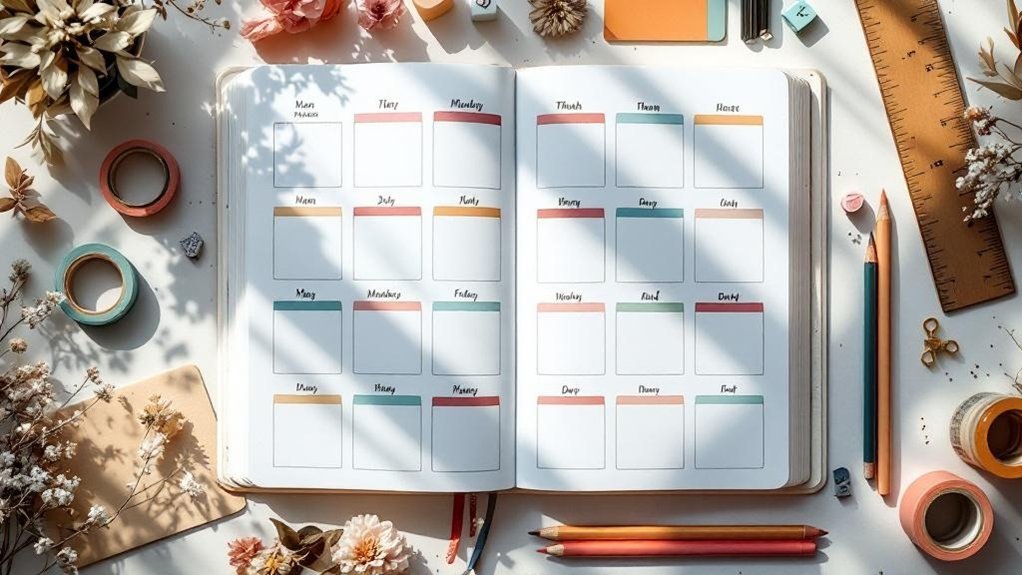
habit trackers are visual tools that help you monitor behaviors over weeks or months. A popular format is a weekly matrix where each day is a box, and you mark completions with a bullet or a checkmark. To add flair, color the completed boxes using a light wash of watercolor from your Tombow brush pens. For instance, shade completed boxes in a soft sage green while leaving uncompleted boxes in pale gray. This not only provides quick visual feedback but also creates a pleasing pattern. The time investment for setting up a habit tracker is about 10 minutes initially; thereafter, marking each day takes just a few seconds, reinforcing the habit while keeping your journal aesthetically pleasing.
Adding Visual Flair: Hand Lettering, Doodles, and Color
Hand lettering transforms ordinary words into artwork, making each page feel personal and engaging. Begin with basic strokes using a fine‑tip brush pen. The Tombow dual brush pens you purchased allow for thin up‑strokes and thick down‑strokes, ideal for creating serif and sans‑serif letters. Spend a short practice session—about five minutes—replicating simple letters like “B” and “E” to develop muscle memory. As you become comfortable, experiment with variations in thickness, adding small flourishes at the end of ascenders.
Incorporate doodles as visual anchors for your text. Simple icons such as a coffee cup for “morning routine” or a lightning bolt for “inspiration” can be drawn with the same brush pen, using a lighter pressure to keep them subtle. To maintain consistency, decide on a limited palette: maybe three colors per page. For example, use a deep burgundy Prismacolor pencil for headings, a teal for bullet points, and a mustard yellow for doodles. This constraint prevents visual clutter while still allowing creative expression.
Color itself is a powerful storytelling tool. When you want to highlight a priority task, apply a bold orange colored pencil to the bullet point. For lighter emphasis, use a pastel pink watercolor wash from your Tombow pens. The cost of Prismacolor pencils is $14.99 for a 12‑color set, but each pencil lasts for hundreds of pages, making the per‑use cost negligible. If you wish to expand your color range without breaking the budget, look for individual packs of colored gel pens that sell for $1.99 each; a 6‑pack adds variety for a fraction of the price of premium sets.
Consider the placement of color strategically. In a habit tracker, coloring completed boxes in a single hue creates a gradient effect that is pleasing to the eye. In collections, alternating colored lines between entries can guide the reader’s eye down the page. For instance, draw thin horizontal lines in alternating light blue and lavender every few lines of text. This technique, known as “ruled background,” provides structure while adding personality. To achieve this, use a fine‑line ruler (approx. $2.49) and a light‑handed HB pencil to sketch the lines before writing, ensuring they don't interfere with readability.
Finally, don't underestimate the impact of negative space. White space allows the eye to rest and makes colored elements pop. When you fill an entire page with text and colors, the journal can feel chaotic. Instead, aim for a balanced composition where roughly 30 % of the page is occupied by design elements, leaving 70 % for written content. This principle not only enhances readability but also reinforces the creative mindset: you are curating what you present, not merely dumping information.
Integrating Digital Tools with Analog Pages
While bullet journaling thrives on tactile experiences, blending digital assistance can enhance organization and creativity. One popular approach is to scan completed pages into a cloud‑based note‑taking app such as Evernote or Notion. Using a smartphone camera, you can capture a high‑resolution image of a spread in under 30 seconds, then tag it with keywords like “habit tracker Feb 2024.” Evernote’s subscription costs $7.99 per month, but many users find the free version sufficient for archiving a few hundred pages.
Digital sketching tablets, like the Wacom One ($149), can complement your hand‑drawn elements. If you enjoy detailed illustrations but find hand‑drawn linework time‑consuming, a tablet allows you to import your bullet journal pages, add vector graphics, and experiment with layers. However, for a budget‑friendly option, consider using a free app such as Procreate on an iPad, which mimics traditional drawing tools without the need for additional hardware. The initial cost of an iPad ($329 for the entry‑level model) is a one‑time investment, and the app itself is $9.99, bringing the total to around $340 for those who already own a device.
Another practical integration is the use of QR codes. You can generate a QR code that links to a digital checklist or a playlist of background music that fuels creativity. Create QR codes online for free using services like QR Code Generator. Print them with a small adhesive label and place one on your habit tracker page. When you complete a week of meditation, scanning the QR code might play a short guided meditation audio, reinforcing the habit loop. This blend of analog and digital turns the journal into a multi‑sensory tool that bridges physical and virtual worlds.
Don't overlook the power of simple spreadsheets for tracking finances or project budgets related to your creative pursuits. A Google Sheets template (free) can hold columns for “Expense,” “Amount,” and “Date.” By linking entries back to specific journal pages, you create a seamless record of how much you spend on supplies like your Pilot G2 pens or new colored pencils. This practice not only keeps your creative habit sustainable but also provides data for future purchasing decisions, ensuring you stay within a $100 annual art supply budget.
Finally, consider a minimalist approach to digital integration: use a single note‑taking app to store images of your bullet journal spreads, tag them, and search them later. This eliminates the need for multiple platforms and keeps everything in one place. By setting aside 5 minutes each month to upload new pages, you ensure a digital backup without overwhelming yourself with administrative tasks. The result is a hybrid system where the tactile joy of writing coexists with the convenience of searchable digital archives.
Making It a Sustainable Habit
Sustainability in bullet journaling is about creating a routine that feels natural, not forced. Begin by anchoring your journal to an existing daily habit, such as morning coffee or bedtime reading. When you already spend 10‑15 minutes on that activity, add a two‑minute window to glance at your bullet journal and note the top three tasks for the day. This habit stacking reduces the mental load of starting from scratch
Your Weekly Dose of Inspiration
Journaling ideas, family tips, and gentle inspiration.
Love this content?
Join the BulletJournals.net community for exclusive tips, guides, and updates.
Subscribe Free