- In This Article
- Key Takeaways
- The Foundation: Your Minimalist Grid System
- Annual Overview & Goal Setting Templates
- Streamlined Monthly & Weekly Layouts
- Essential Habit & Fitness Trackers
- Project Planning & Brain Dumping Templates
- Download Your Ready-Made Templates
- Sources & further reading
- FAQ
- What's the best notebook for these minimalist templates?
- I'm new to bullet journaling. Which 3 templates should I start with?
- My pens keep bleeding through the paper. What should I do?
- Related Articles
Ready to make 2026 your most organized year yet but worried about spending hours designing layouts? I've filled over 20 journals since 2018, and I can tell you the secret: minimalist templates are the ultimate game-saver. They give you the structure you crave without the pressure to create a masterpiece every week. This collection of 40 templates is designed to get you from overwhelmed to in-control, whether you're tracking fitness goals, managing a side hustle, or just trying to remember to water the plants. The best part? Each one is built on a simple grid system and uses pens you probably already own, like the reliable Micron 05. Forget the stress of a blank page—let's build your 2026 system together.
6 min read
In This Article
Key Takeaways
- The Foundation: Your Minimalist Grid System
- Annual Overview & Goal Setting Templates
- Streamlined Monthly & Weekly Layouts
- Essential Habit & Fitness Trackers
The Foundation: Your Minimalist Grid System
Every great minimalist spread starts with a consistent grid. After testing dozens of journal sizes, I've found that a 5mm dot grid, like in the popular Leuchtturm1917 or Archer & Olive notebooks, offers the perfect balance of flexibility and structure. For these templates, we'll use a base unit of 4×4 dots (which equals 2cm x 2cm). This creates clean, proportional boxes without needing a ruler for every single line. I once tried using a 7-dot grid, thinking bigger boxes would be faster, but it actually made my layouts feel clunky and wasted space. The 4-dot unit is the sweet spot.
Your essential tools are simple. A mechanical pencil (I swear by the Pentel GraphGear 500, 0.5mm lead) for drafting, a clear acrylic ruler for straight lines, and your inking pens. For the main lines of your templates, a Sakura Pigma Micron 05 in black is perfect—it's fine enough for precision but bold enough to be clearly defined. Need a budget alternative? The Staedtler Triplus Fineliner 0.3mm is a fantastic option. Give yourself about 15-20 minutes to set up a weekly or monthly spread once you get the hang of the grid.
Give yourself about 15-20 minutes to set up a weekly or monthly spread once you get the hang of the grid.
Annual Overview & Goal Setting Templates
Kick off 2026 with a clear vision. The “Year at a Glance” template uses a simple 12-column layout, one for each month. Each column is 14 dots wide (7cm), giving you plenty of space to jot down key dates, birthdays, and goals. I use a Tombow Dual Brush Pen in N75 (a cool gray) to lightly shade the current month. A “Goal Breakdown” spread is crucial—I divide a two-page spread into four quadrants (each 20 dots by 28 dots) for Health, Career, Personal, and Financial goals. Under each, I create a small tracker to log progress weekly. When I skipped this step in 2024, my goals felt vague and I lost momentum by March.
Another powerful template is the “Future Log” for capturing ideas that don't have a date yet. Create six boxes, two columns by three rows, each 18 dots tall. Label them with the months (Jan-Jun on the left page, Jul-Dec on the right). This took me 10 minutes to set up and saved me from cluttering my weekly spreads all year. Use a ruler and your Micron 05 for the boxes, and a Tombow Fudenosuke hard tip brush pen for the monthly headers.
Streamlined Monthly & Weekly Layouts
Your monthly log should be functional, not fussy. The classic “Calendar Block” layout is my go-to. On one page, create a grid of 5 rows by 7 columns for the days. Each block is 8 dots high by 8 dots wide (4cm x 4cm). This leaves a margin at the top for the month's name and a sidebar for monthly goals or notes. I made the mistake of making the blocks too small (5×5 dots) once, and it was impossible to write anything meaningful. The 8×8 dot block is the perfect size for 2-3 brief events per day.
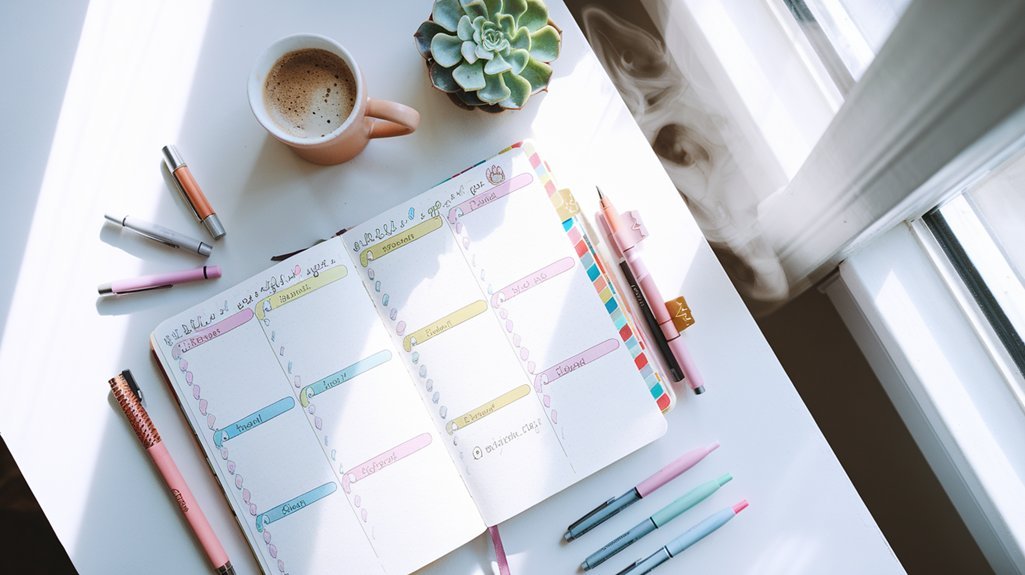
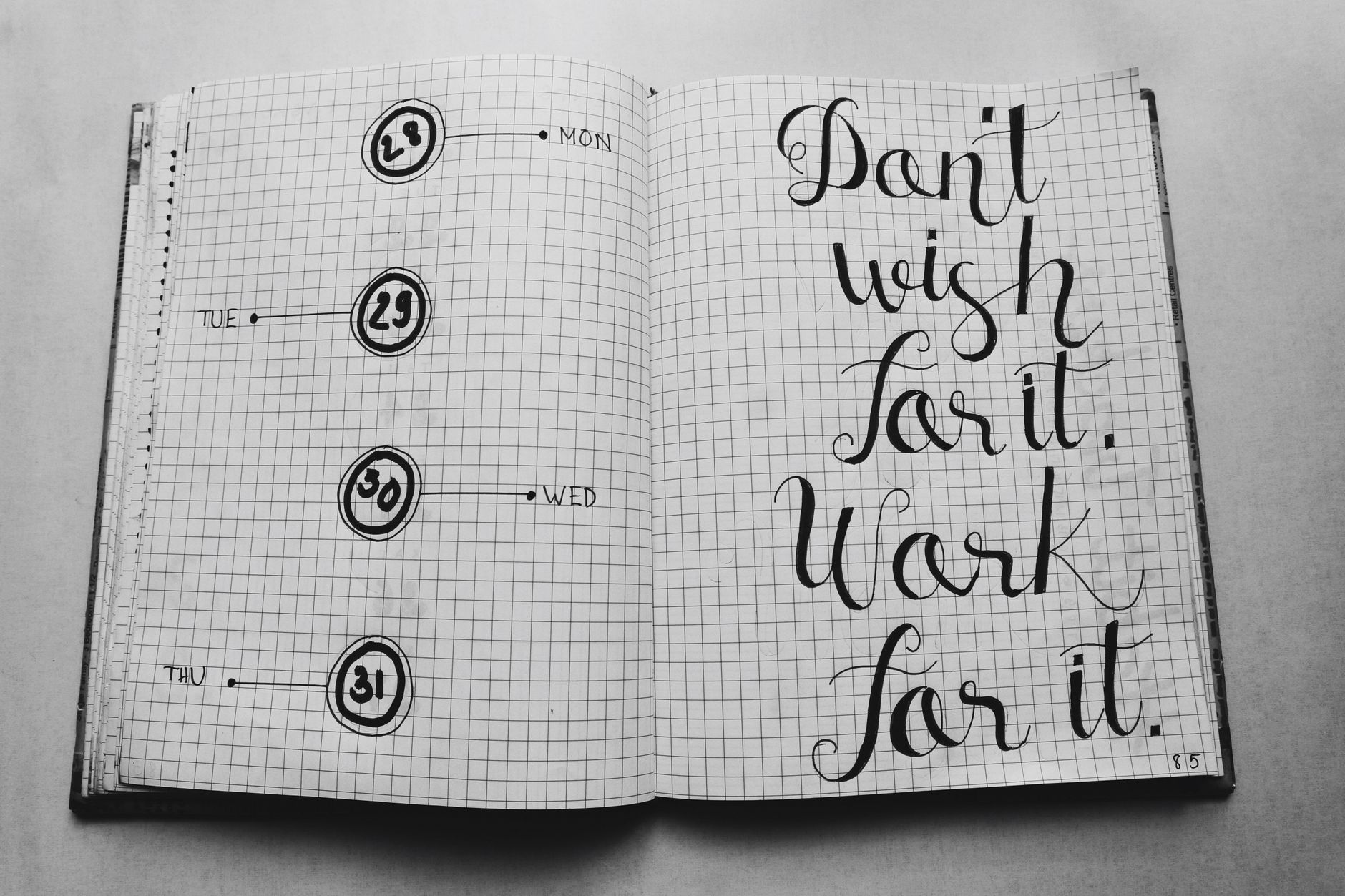
For weekly spreads, simplicity is key. The “Aligned Left” layout is incredibly efficient. On a two-page spread, create a narrow column on the far left (6 dots wide) for the dates. Then, create seven sections for each day, each 24 dots tall. This gives you a vertical timeline for your day. I use the top 8 dots of each section for scheduled appointments and the bottom 16 dots for tasks and notes. Setting this up takes about 12 minutes with a ruler. I use a gray Mildliner to subtly shade the weekend columns, creating a visual break.
I use a gray Mildliner to subtly shade the weekend columns, creating a visual break.
Essential Habit & Fitness Trackers
Habit trackers are where minimalism truly shines. A full-page grid tracker can become overwhelming. Instead, try a “Horizontal Bar” tracker. List 10-12 key habits down the left side of a page. Then, for each habit, draw a long rectangle, 4 dots tall and 120 dots long (the width of the page). Each day, you simply fill in a 4×4 dot square within that bar if you completed the habit. It's visual, compact, and takes only 8 minutes to draw. I used to create elaborate mood mandalas, but filling them in felt like a chore. This bar method is sustainable.
For fitness, a “Weekly Metrics” box is perfect. Create a section on your weekly spread that's 16 dots tall by 28 dots wide. Divide it into four small boxes for tracking water intake, steps, workout duration, and sleep. I use a Tombow Dual Brush in 173 (a light green) to color-code the “water” box and 856 (blue) for “sleep.” This immediate, at-a-glance view keeps me accountable without needing a separate dedicated spread.
Project Planning & Brain Dumping Templates
When you have a big project—like planning a vacation or launching a blog—a dedicated spread prevents mental clutter. The “Project Sprint” template uses a two-page spread. On the left, create a large “Brain Dump” area, a simple box measuring 38 dots by 52 dots. Get every thought out of your head. On the right page, create three sections: “Next Actions” (20 dots tall), “Waiting On” (16 dots tall), and “Notes” (16 dots tall). This separation was a revelation for me; it stopped me from re-reading the same messy brainstorm daily.
Another favorite is the “Password Log,” a security must-have. Create a grid with columns for Website, Username, and Password. Make this spread discreet—don't label the page obviously. I use a simple cipher only I understand for the passwords themselves. This template took 5 minutes to create and has saved me hours of “forgot password” clicks. Always use a pencil for the actual sensitive information.
Download Your Ready-Made Templates
Love the ideas but short on time? I've created a printable PDF pack with all 40 templates mentioned, perfectly sized for A5 journals. Each template is built on the 5mm grid system and includes faint guide lines for cutting or tracing. The PDF is 28 pages and includes variations for both left- and right-handed writers. You can print them on standard paper, but for a feel closest to your journal, I recommend 100gsm smooth bleed-proof paper.
To use them, simply print, cut along the guidelines, and glue them into your journal using a glue stick like the UHU Stic. I've found that a quick pass with a bone folder after gluing ensures they lie completely flat. The whole download-and-setup process for a month's worth of spreads should take less than 30 minutes. It's the fastest way to get a professional, organized system running for January 2026.
Small changes, real momentum
Get practical guides and templates you'll actually use — a few thoughtful emails a month.
Sources & further reading
- 40 (number) (en.wikipedia.org)
- 40 (number) (simple.wikipedia.org)
FAQ
What's the best notebook for these minimalist templates?
I highly recommend a notebook with a 5mm dot grid, like the Leuchtturm1917 A5 Hardback. The paper is 80gsm, which handles fineliners like Microns well with minimal ghosting. If you prefer thicker paper to prevent bleed-through, the Archer & Olive A5 notebook uses 160gsm paper. Both have 180 pages, which is ample for a full year of minimalist spreads without the journal becoming too bulky.
I'm new to bullet journaling. Which 3 templates should I start with?
Start simple to avoid burnout. First, set up the “Year at a Glance” future log to capture appointments. Second, create a basic “Aligned Left” weekly spread for your first week of January. Third, choose just one “Horizontal Bar” habit tracker with 5 key habits, like hydration, reading, and movement. Master these three over a month before adding more complex project planners. This foundational system took me about 45 minutes to set up for my first month and required zero artistic skill.
My pens keep bleeding through the paper. What should I do?
Bleeding is often a pen-and-paper mismatch. If you're using a Leuchtturm (80gsm paper), switch to fineliners like Staedtler Triplus or Pilot Hi-Tec-C, which have less ink flow than brush pens. For any paper, do a swatch test on the last page first. If ghosting (seeing the writing on the other side) bothers you, a sheet of black paper behind the page you're writing on completely eliminates the distraction. I've found this trick works better than searching for the perfect “no ghosting” notebook.
Your Weekly Dose of Inspiration
Journaling ideas, family tips, and gentle inspiration.
Love this content?
Join the BulletJournals.net community for exclusive tips, guides, and updates.
Subscribe Free